x094 ABBY KORTRIJK [2025]
Kortrijk, BE
Barozzi Veiga
Ceramics
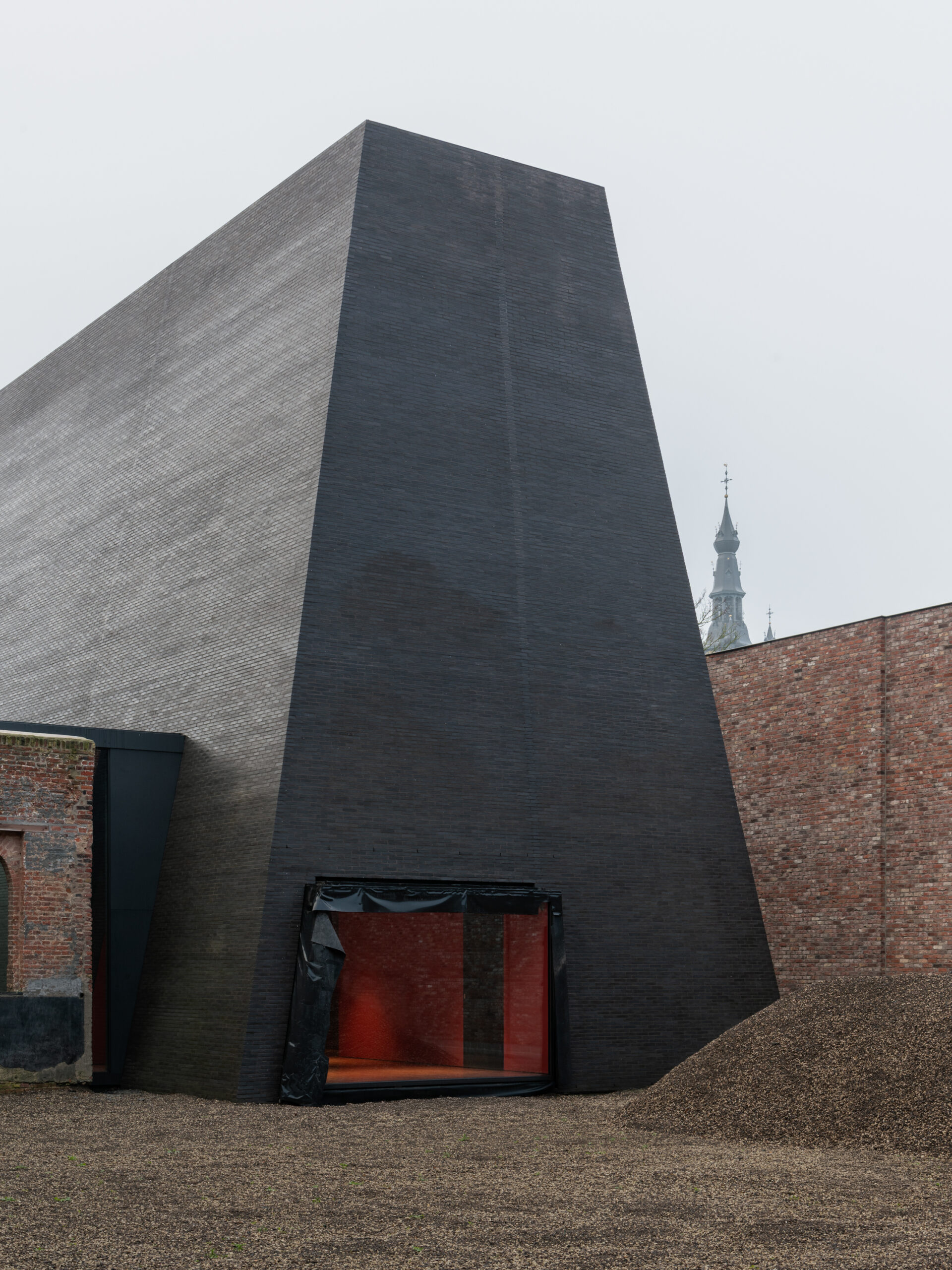


Le concept de générer un dialogue fort entre les toitures pentues de l’Abbaye existante et le nouveau volume du restaurant s’est cristallisé dans une nouvelle façade… qui voudrait être un toit.
Ces nouvelles façades inclinées (78 et 84 degrés) devaient composer un corps monolithique formé de quatre plans pentus sans ombres, quatre surfaces parfaites, encore plus abstraites que les géométries en tuiles et briques des bâtiments voisins existants.
Parallèlement, l’idée de travailler avec un matériau existant ou recyclé a commencé à prendre forme. Il a été découvert qu’une brique recyclée était produite près d’Arnhem, aux Pays-Bas, à 270 km du site. Ce fabricant nous permettait de travailler avec 60 % de déchets recyclés et 40 % d’argile, en produisant une brique sur mesure, spécifiquement conçue pour répondre aux besoins du projet, en termes de performance, de couleur, de géométrie et de texture.
La proportion d’argile (40 %) a été ajustée afin d’utiliser une argile rouge allemande de haute performance, provenant de la région, qui a permis d’obtenir une brique très résistante, à faible absorption d’eau (6 %), tout en atteignant cette couleur gris foncé intense qui était voulue.
Les briques ont été cuites à une température plus basse que les briques standards, tout en conservant une qualité équivalente, grâce à la présence de matériaux céramiques déjà "cuits" dans leur composition. En tout, 92 tonnes de déchets céramiques ont été revalorisées dans ce projet.
La géométrie des briques a intégré des pans inclinés (panneresses et boutisses), générant six types de briques : deux pièces standards correspondant aux deux principales inclinaisons des façades, et deux fois deux pièces d’angle spéciales. Cette stratégie, complétée par la conception de joints en mortier teinté gris foncé, a permis de préserver la clarté des formes abstraites de l’ensemble du bâtiment.
Team
Architecture : Barozzi Veiga + TAB Architects avec Koplamp Architecten (Patrimoine) / Ingénieur Civil : Sileghem & Partners / Physique du Bâtiment : Daidalos Peutz / Photographie : Simone Marcolin / Planification enveloppe : xmade
The concept of generating a strong dialogue between the existing steep roofs of the Abbey and the new volume of the Restaurant, crystalized in a new Façade that would like to be a Roof…
These new inclined Façades (78 and 84 degrees) had to generate a monolithic body composed by four steep planes without shadows, four perfect surfaces, even more abstract than the geometries built with the ceramic tiles and the bricks on the existing buildings beside of the Abbey.
In parallel, the idea of working with an existing or a recycled material started to take form as well. It was found that a recycled brick was produced close to Arnhem, in the Netherlands, at 270Km from the site. This manufacturer would allow us to work with 60% of upcycled waste and 40% of clay, producing a bespoke brick, specially designed for the needs of the project, in terms of performance, color, geometry and texture.
The 40% clay content was manipulated, in order to use a German close-by high-performance red clay that allowed the brick to be a very performative, highly resistant, low water absorption brick (6%) and, at the same time, to achieve its characteristic dark intense gray color that was ambitioned.
The bricks were fired with a lower temperature than a standard brick and with the same quality, thanks to its already “baked” ceramic waste content. In total, 92 Tm of ceramic waste was upcycled in the project.
The geometry of the bricks incorporated inclined stretchers and headers that generated six types of bricks, two standard pieces with the two main inclinations of the Façades and two times two special corner pieces. This strategy, completed with the design of flush tainted dark gray mortar joints, helped to keep the clarity of the overall abstract shapes of the building.
Team
Architecture: Barozzi Veiga + TAB Architects with Koplamp Architecten (Heritage) / Structural Engineer: Sileghem & Partners / Building Physics: Daidalos Peutz / Photography: Simone Marcolin / Envelope planning: xmade